

Pain on the inside of the elbow can be a serious concern for a baseball player.
A UCL injury may reduce throwing velocity, accuracy, and confidence. However, a partial tear does not always require Tommy John surgery.
Some UCL tears in baseball players can be managed with rest, physical therapy, strength training, changes to workload, and a structured throwing program.
Platelet-rich plasma, also known as PRP, may support recovery in selected cases. Still, it should be part of a complete rehabilitation plan.

What Is a UCL Tear?
The ulnar collateral ligament is located on the inside of the elbow. It helps stabilize the joint during throwing.
Repeated pitching can irritate, stretch, or partially tear the ligament.
Common symptoms include:
- Pain on the inside of the elbow
- Reduced throwing velocity
- Loss of accuracy
- Unusual arm fatigue
- Difficulty recovering between games
- Elbow instability
- Tingling in the ring or little finger
A medical evaluation may include a physical examination, strength testing, MRI, and dynamic ultrasound.

Can a UCL Tear Heal Without Surgery?
Some partial UCL tears respond well to nonoperative treatment.
The result depends on the location and severity of the tear, elbow stability, tissue quality, player position, and throwing demands.
A successful plan usually includes:
- Rest from painful throwing
- Rehabilitation of the kinetic chain
- Progressive strength training
- A graduated interval throwing program
Research shows that successful programs treat more than the elbow. They also improve shoulder strength, core control, hip mobility, and lower-body function.
Where Does PRP Fit?
PRP is made from a sample of the patient’s blood. The blood is processed to create a concentrated solution containing platelets and proteins involved in healing.
A physician may inject PRP near the injured ligament using ultrasound guidance.
However, PRP cannot correct:
- Poor throwing mechanics
- Weak shoulder muscles
- Limited hip mobility
- Poor core control
- Excessive throwing volume
- Sudden workload increases
Therefore, PRP should not replace physical therapy.
Evidence remains mixed. Some athletes return successfully after PRP. However, other studies have not shown a faster return compared with rehabilitation alone.

Phase 1: Protect the Elbow
The first phase often covers the first two weeks.
Throwing should stop if it causes pain. The athlete may also need to avoid heavy lifting, pressing, pulling, or forceful gripping.
Early care may include:
- Relative rest
- Protected elbow movement
- Gentle shoulder and wrist mobility
- Ice or other pain-control methods
- Throwing workload review
- Physician-directed medication
Complete immobilization is not always needed. Gentle, protected movement may help prevent stiffness.
Phase 2: Restore Strength and Mobility
The second phase often begins between weeks two and six.
The goal is to restore pain-free movement and strengthen the muscles that support throwing.
Important areas include:
- Rotator cuff
- Scapular stabilizers
- Forearm muscles
- Grip strength
- Core
- Hips
- Lower body
The elbow is only one part of the throwing motion.
Force begins in the legs and travels through the hips, trunk, shoulders, elbows, wrists, and hands. If one area is weak, the elbow may absorb more stress.

Phase 3: Start the Throwing Program
The interval throwing program may begin between weeks six and twelve. However, some players need more time.
Throwing should begin only when the player has:
- Little or no elbow pain
- Pain-free range of motion
- Improved shoulder and forearm strength
- Good scapular control
- Tolerance to strength exercises
A typical progression may include:
- Short-distance flat-ground throwing
- Gradual increases in distance
- Controlled long toss
- Higher-intensity throws
- Position-specific drills
- Mound work for pitchers
- Bullpen sessions
- Live batting practice
- Simulated innings
- Controlled competition
Each stage should be completed without pain.
If symptoms return, the athlete may need to reduce throwing volume, repeat an earlier stage, or receive another medical evaluation.

How Long Does Recovery Take?
Many athletes with lower-grade partial tears may return to competitive throwing in about three to four months.
Recovery may take longer when the athlete has:
- A higher-grade tear
- Elbow instability
- Previous elbow injuries
- Ulnar nerve symptoms
- Limited shoulder or hip mobility
- Significant strength deficits
- Poor throwing mechanics
The goal is not to follow the fastest timeline. The goal is to follow the safest plan for the athlete.
Progress should depend on symptoms, strength, movement, and throwing tolerance.
When Is a Player Ready to Compete?
There are no universal return-to-competition standards for nonoperative UCL treatment.
Before returning, the athlete should usually demonstrate:
- Full and pain-free elbow motion
- No tenderness over the UCL
- Restored shoulder and forearm strength
- Adequate hip and core strength
- Completion of the throwing program
- Completion of mound progression for pitchers
- No pain during or after throwing
- Normal recovery between sessions
- Confidence in the throwing arm
Being cleared to throw is not always the same as being ready for unrestricted competition.
When Should Surgery Be Considered?
Surgery may be discussed when a player has:
- A complete UCL tear
- Significant elbow instability
- Ongoing pain after rehabilitation
- Repeated failure during throwing progression
- Inability to compete at the required level
- Additional elbow injuries
PRP should not delay surgery when the ligament cannot safely handle the athlete’s throwing demands.
The Value of Baseball-Specific Testing
A baseball performance assessment can identify physical limitations that may increase elbow stress.
Testing may include:
- Shoulder strength ratios
- Grip strength
- Shoulder and hip mobility
- Scapular control
- Core strength
- Lower-body power
- Throwing mechanics
- Recent workload
Testing can be performed before the season, during rehabilitation, and before returning to competition.
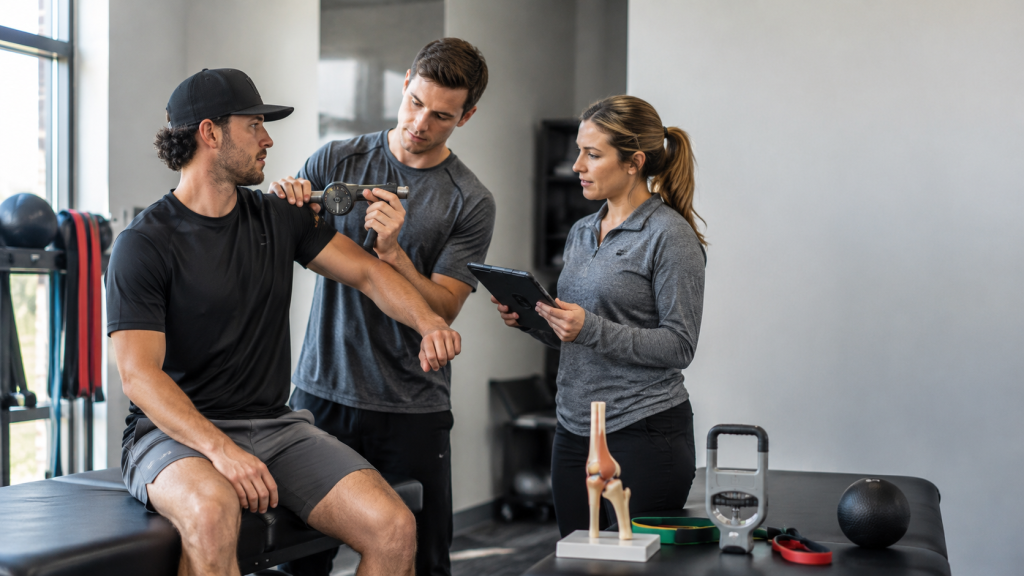 Need Help Managing a UCL Tear?
Recovering from a UCL injury requires more than resting until the pain improves.
A complete program should restore movement, improve strength, manage throwing volume, and prepare the athlete for competition.
Our staff develops baseball-specific rehabilitation, arm care, and throwing programs. We can also work with physicians, athletic trainers, pitching coaches, and performance coaches.
Contact our team to learn more about a personalized UCL rehabilitation program.
Frequently Asked Questions
Can PRP heal a UCL tear?
PRP may support healing in selected partial tears. However, it cannot guarantee recovery or repair every type of UCL injury.
Is PRP better than physical therapy?
Current evidence has not shown that PRP is consistently better than rehabilitation alone. Physical therapy and workload management remain essential.
How long after PRP can a player throw?
The timeline varies. Throwing should begin only when pain, movement, strength, and clinical testing support progression.
Can a pitcher avoid Tommy John surgery?
Some pitchers with stable partial tears can return without surgery. Complete tears, instability, or failed rehabilitation may increase the likelihood of surgery.
Medical Disclaimer
This article is for educational purposes only. It does not replace an examination, diagnosis, or treatment plan from a qualified healthcare professional.
References
- Conservative Treatment After a Partial UCL Injury
https://pubmed.ncbi.nlm.nih.gov/31194648/ - UCL Rehabilitation Protocols
https://pubmed.ncbi.nlm.nih.gov/38702939/ - Free Full-Text UCL Rehabilitation Review
https://pmc.ncbi.nlm.nih.gov/articles/PMC11569531/ - Nonoperative UCL Treatment With and Without PRP
https://pubmed.ncbi.nlm.nih.gov/31589470/ - PRP Treatment for Partial UCL Tears — Free Full Text
https://pmc.ncbi.nlm.nih.gov/articles/PMC5686880/ - Return to Sport After Nonoperative UCL Treatment
https://pubmed.ncbi.nlm.nih.gov/36876746/ - Long-Term Return-to-Play Outcomes
https://pubmed.ncbi.nlm.nih.gov/33720760/ - Rehabilitation and Throwing Program Milestones
https://pubmed.ncbi.nlm.nih.gov/35532953/
[/vc_column_text][/vc_column][/vc_row]